Cookie Law Compliance: Free Open Source Tools to Manage Consent


With the arrival of the GDPR in 2018, the Cookie Law issued in 2014 began to show some weaknesses. Lawmakers strengthened it, and since the beginning of 2022 all website owners must comply with the new cookie guidelines.
At Qboxmail, we have always been very attentive to the respect of our users’ privacy, and we have analyzed the offer of Cookie Consent services and software currently available on the market, with the aim of identifying one suitable for our services.
In this article we’re going to summarize our analysis and comparison of some open source projects designed to meet the need to bring your website or application into compliance with the management of user consent of cookies.
Comparison of the Main Open Source Software for Cookies Consent
In order to comply with the current Cookie Law, you can rely on open source projects. Three projects stand out as the main and most advanced ones, created by the following companies or developers:
Let’s analyze their features in detail:
Klaro
Klaro is a European company that provides compliance services in Data protection and Cookie management for websites. The open source part of the code of their consent management platform (CMP) service, related to the front-end, is available on Github. The commercial version also offers a centralized panel where you can track and manage user consents. The project includes multi-language management.
Osano / Cookieconsent
Osano, a US company focused on privacy management solutions, developed Cookieconsent. Cookieconsent is the open source version of their front-end.
OrestBida / Cookieconsent
Italian freelancer Orest Bida developed the Cookieconsent project. Unlike the previous two, it is not the open source version of a commercial service but a free and independent framework for managing cookies on websites. The project supports multiple languages and includes clear documentation.
How to Integrate Cookie Consent Services into your Website or Application
Each proposed solution requires you to add a JavaScript script to your page. You can install it with a simple link to a public CDN or integrate it into your own JavaScript files by downloading and installing it via NPM.
Which Cookie Consent Service to Choose
Among the 3 solutions, the simplest is certainly Osano / Cookieconsent (GitHub repository here). Through the Osano site it is possible to directly configure the banner through their configurator, which then provides the code to be copied on your web page.
This plugin is very simple, great for small sites that don’t use a lot of cookies, as it doesn’t offer granular control over the cookies used. It simply offers a way of letting the user know that the site uses cookies and the ability to refer to their own Privacy page. The plugin offered by Osano is open source but it is possible at a later time to connect it to the service offered by Osano itself. In this case, you will have a number of more advanced features and a fully configurable installation using the Osano application.
More advanced and with granular control of all cookies are Klaro (GitHub repository here) and OrestBida / Cookieconsent (GitHub repository here). These Javascript plugins offer a mobile-friendly, high-performance and lightweight widget that can be easily integrated into any web page. Once installed, a complete interface is available where the user can see the complete details of the cookies used.
Both plugins make it easy to “block” external scripts (such as Google Analytics) until the user has decided whether to give their consent or not. In case of consent, the scripts are “re-inserted” in the page and initialized, thus activating their normal operation.
Aesthetically OrestBida / Cookieconsent is more neutral and therefore it is easier to adapt it to the graphics of your website, WordPress theme or application.
Klaro, like Osano, offers the possibility of connecting to their service to have more advanced features such as tracking consents and collecting statistics.
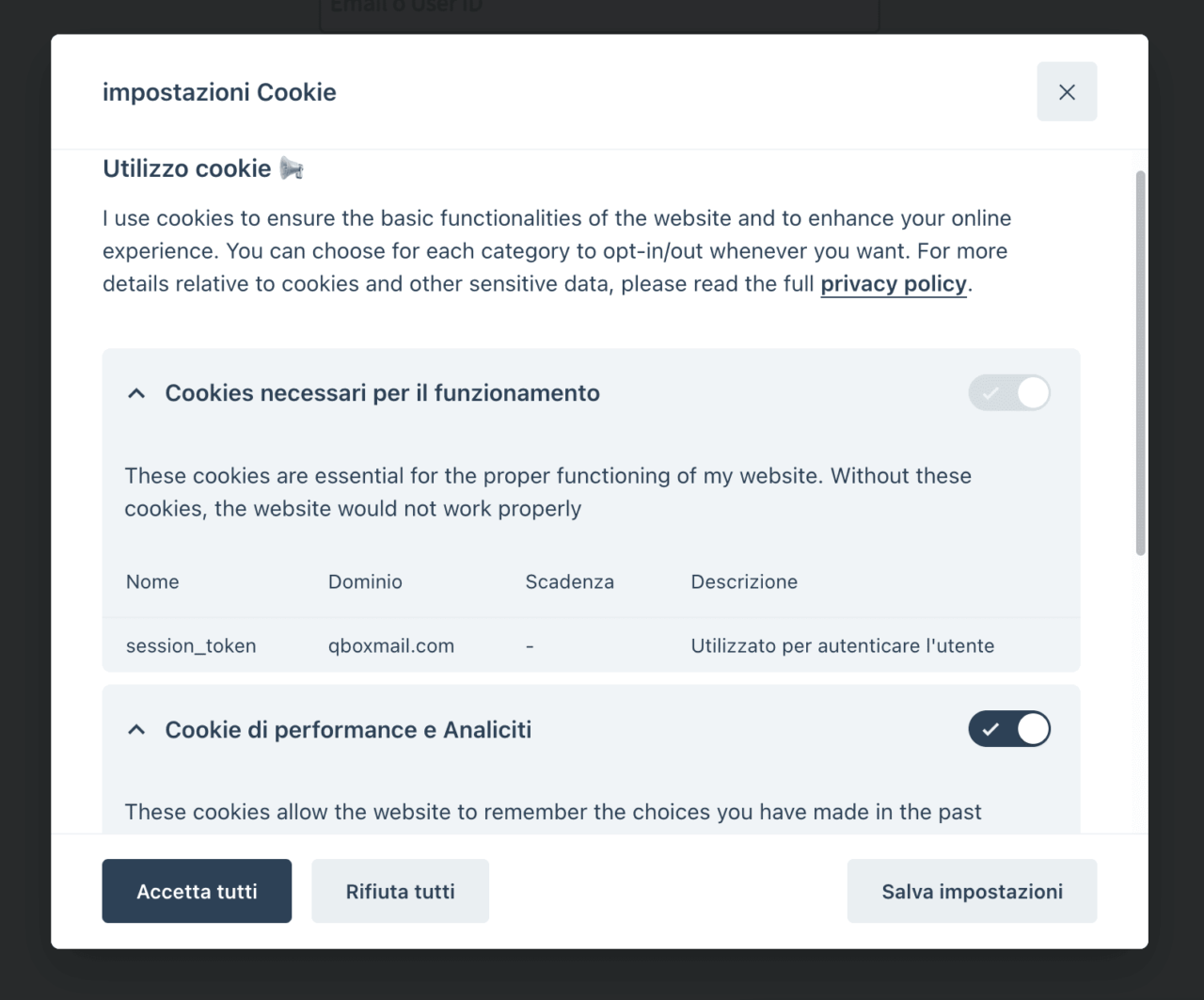
On which Applications Should the Banners for Requesting Consent for Cookies be Inserted?
The answer is simple, in all applications (websites, management applications, control panels, Apps) that can track and profile user activities through cookies. Even your Smart TV has to display the banner.
In theory, a website or application that creates and reads only technical cookies, always necessary for the functioning of the application itself, can avoid asking the user to choose which cookies to enable, in fact technical cookies are always allowed. While al lthe applications that create and read also profiling and third-party cookies must by law display the banner.
The Qboxmail team designs and develops all its services and products in Europe. It has always made sure to apply all the GDPR and cookie consent provisions to guarantee the protection of the personal data of its Users and Customers.
Click here to know in detail how Qboxmail applies the provisions of the GDPR.